Hypersonic Boundary-Layer Transition Special Interest Group
Hypersonic Boundary-Layer Transition SIG
The Hypersonic Boundary-Layer Transition (HBLT) Special Interest Group brings together researchers from academia, industry and government to address one of the central challenges in hypersonic flight: understanding, predicting and controlling the transition from laminar to turbulent flow. The SIG aims to consolidate and energise the UK research community, stimulate new collaborations and training activities, showcase UK capability, and develop the scientific foundations for a future flight experiment investigating hypersonic boundary-layer transition.
About the SIG |
Boundary-layer transition is a key scientific challenge in hypersonic flight. The change from laminar to turbulent flow can produce substantial increases in surface heating and aerodynamic drag, with important consequences for vehicle performance, thermal protection and design. Despite decades of research, accurately predicting when and how transition occurs under realistic hypersonic flight conditions remains challenging. Important uncertainties remain in the underlying physical mechanisms, experimental and simulation techniques, the relationship between ground-test and flight disturbance environments, and the availability of suitable flight data.
The HBLT SIG provides a forum for the UK community working on these challenges to exchange knowledge, establish new collaborations and coordinate activities. It contributes to the Network's wider ambition to build the scientific and technical foundations for a future UK-led hypersonic flight experiment.
The SIG runs from July 2026 to June 2028, with hybrid meetings approximately four to six times each year alongside wider UK Hypersonics Network forums. The SIG currently has approximately 70 members from academia, industry and government across the UK, with strong representation from early-career researchers.
Our aims |
The SIG is organised around three closely connected themes:
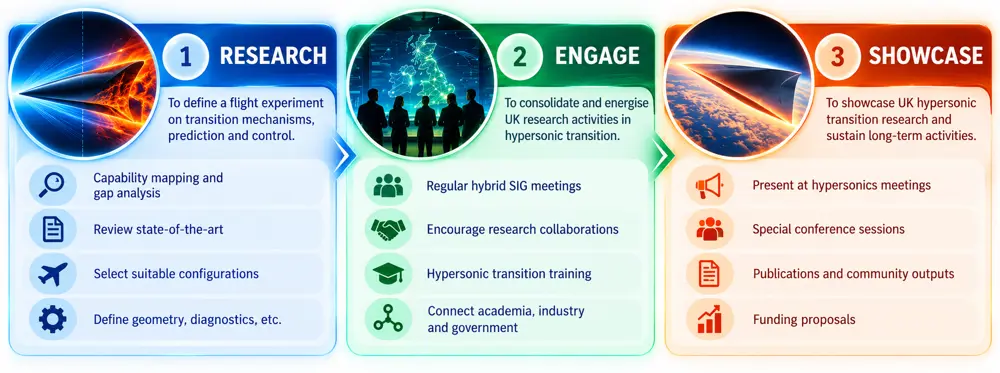
Research: Towards a hypersonic transition flight experiment |
A major focus of the SIG is to help define the scientific case for a future hypersonic boundary-layer transition flight experiment. Flight data are particularly valuable because transition is highly sensitive to the disturbance environment and because reproducing all aspects of realistic flight simultaneously in ground-test facilities is difficult. The SIG therefore aims to identify the scientific questions for which flight testing could provide the greatest benefit and to build the research base needed to formulate a credible experiment.
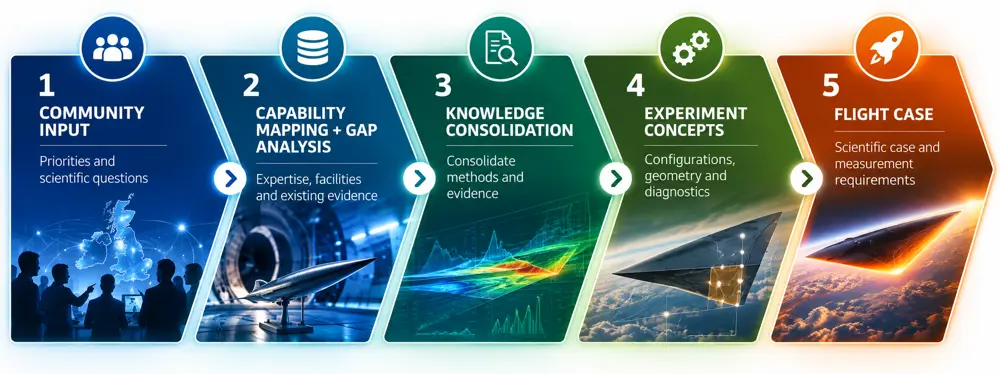
The activity combines UK capability mapping and gap analysis with consolidation of existing knowledge and methods, followed by the development of candidate experiment concepts. The process of defining a flight test experiment on hypersonic boundary-layer transition is a common challenge which will be addressed using the combined expertise of UK researchers in the SIG community.
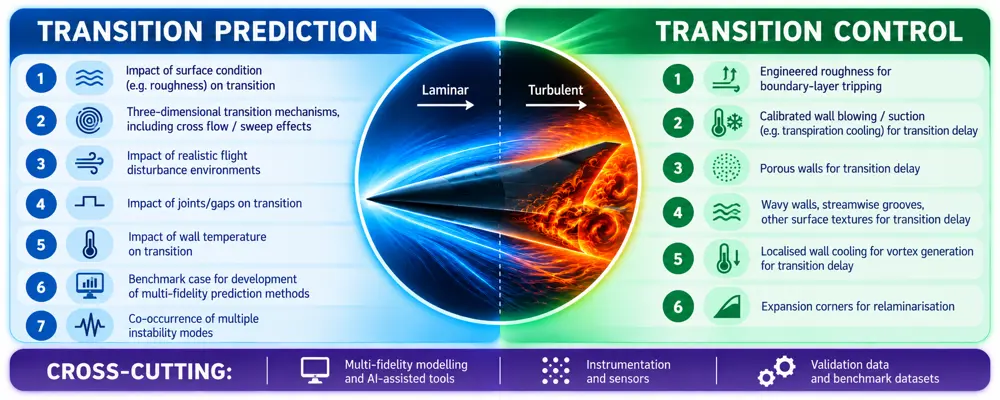
Scientific priorities |
The SIG is considering a broad range of scientific questions relevant to transition prediction and control. The themes listed are being considered by the community and prioritised for integration into the flight test experiment.
Engage: Building the UK hypersonic-transition community |
A second major objective is to develop a connected and active UK community in hypersonic boundary-layer transition. The SIG provides regular opportunities for researchers to meet, present work in progress, exchange expertise and identify complementary capabilities. Activities include hybrid SIG meetings, dedicated discussions at UK Hypersonics Network forums and collaborative sessions designed specifically to identify new research partnerships.
Particular emphasis is placed on turning these interactions into tangible collaborative activities. Members are encouraged to identify overlaps in their research, contribute expertise to existing projects, establish proof-of-concept studies and develop new projects addressing SIG priorities. Training is another important strand, with the SIG developing hypersonic boundary-layer transition training course that will draw upon expertise distributed across the UK community and support the next generation of hypersonics researchers.
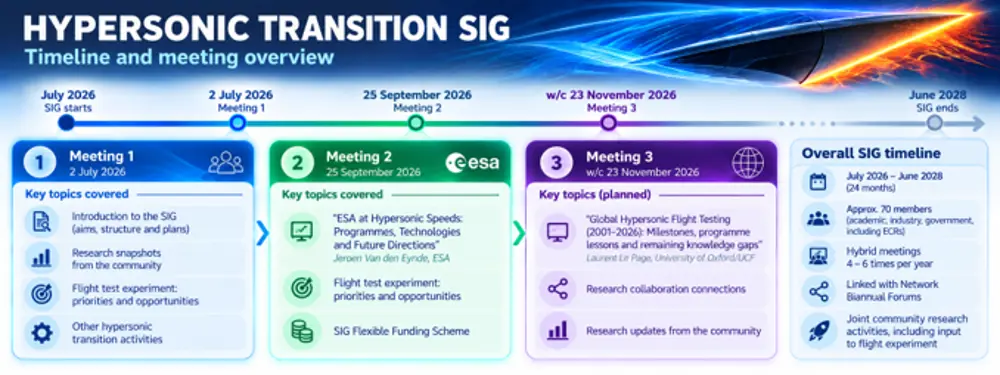
Supporting new research and collaboration |
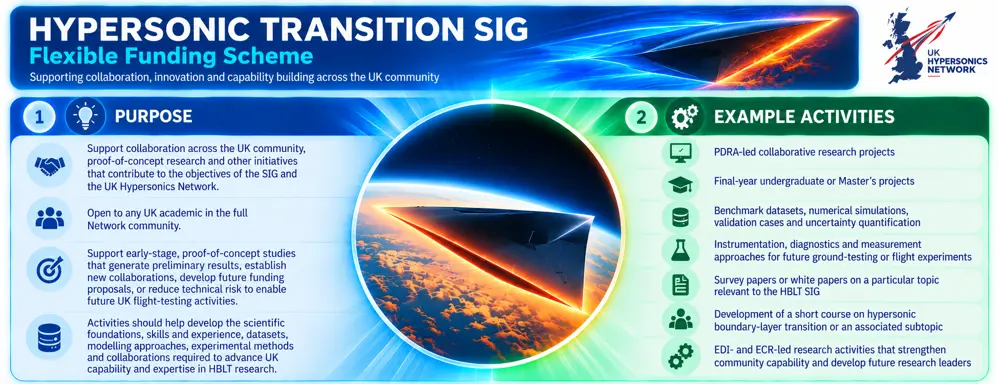
The SIG Flexible Funding Scheme enables small-scale activities that contribute directly to the SIG objectives. The scheme is intended particularly to support early-stage and proof-of-concept work that can generate preliminary results, establish new collaborations, underpin future funding proposals or reduce technical risk associated with future UK flight-testing activities.
Showcase: Strengthening the visibility of UK research |
The SIG aims to provide a focal point through which the breadth and quality of UK research in hypersonic boundary-layer transition can be communicated to the wider hypersonics community. This includes showcasing research through UK Hypersonics Network activities, participation in national and international conferences, dedicated conference sessions, publications (including special issues in journals) and coordinated community outputs. The SIG also seeks connections with complementary national and international activities so that UK expertise contributes to - and benefits from - the wider hypersonics research community.
Get involved |
The HBLT SIG welcomes participation from researchers and practitioners across academia, industry and government, including early-career researchers and doctoral researchers. Members can contribute by presenting research or work in progress at SIG meetings; contributing to capability mapping, gap analyses or literature reviews; proposing scientific priorities for future flight testing; participating in collaborative research and proof-of-concept studies; contributing to training activities; developing publications or funding proposals; or providing technical expertise, facilities, data and other resources relevant to the SIG's objectives.
To register your interest, and get involved with the SIG, please contact Adriano Cerminara (Cranfield University) and Kshitij Sabnis (Queen Mary University of London).
You can also Join the Network to receive updates from the SIGs and working groups in the UK Hypersonics Network.