ECR Working Group, UK Hypersonics Network, University of Oxford
Early Career Researcher Working Group
The Early Career Researcher (ECR) programme forms an integral part of the Network. The programme is designed to support PhD students, postdoctoral researchers, and early career academics, while ensuring that they contribute directly to technical activity. Please contact the Network if you would like to participate (hypersonics-network-uk@eng.ox.ac.uk)
Over recent months, the programme has focused on building connections with student communities already engaged in high-speed flight and aerospace engineering. The ECR programme will continue to expand opportunities for collaboration across institutions while supporting workshops, showcase events, and focused technical activities. The long-term ambition is to develop a connected community of early career researchers who not only engage with the Network but also play an active role in delivering the research, capability and collaboration needed to underpin future UK hypersonic flight experimentation.
Recent activities
The Network was also represented at the Race2Space Symposium on the 10th of July 2026, where the ECR programme engaged with student teams from across the UK and introduced opportunities to become involved in future Network activities. The symposium provided an excellent opportunity to strengthen relationships with the wider student aerospace community and demonstrate how activities such as Race2Space can naturally connect with research in hypersonic flight, diagnostics and experimental validation.
The ECR programme organised a dedicated student visit to the Oxford Thermofluids Institute on the 8th of July 2026
The visit brought together undergraduate students from Race2Space and doctoral researchers from the R2T2 programme for a day centred on experimental hypersonics and community building. Participants were introduced to the objectives of the UK Hypersonics Network before touring the HDT and T6 facilities, where they learned how ground-test facilities are used to investigate high-speed flow physics, develop advanced diagnostics and generate the experimental data required to validate numerical models and support future flight experimentation.
Alongside the facility visits, students participated in a technical challenge workshop based around a £5k collaborative project exercise. Working in multidisciplinary teams, participants were asked to identify a technical challenge relevant to one of the Network's Special Interest Groups and develop a realistic project that could be delivered over a three to six-month period with modest funding. The exercise encouraged students to think beyond their own research projects, consider collaborative approaches across institutions and disciplines, and explore how relatively small technical activities could contribute to the longer-term ambitions of the Network.
An important milestone at the Forum was the introduction of the first ECR Showcase during the UK Hypersonics Network Biannual Forum on the 6th of July 2026. The showcase provided undergraduate students, doctoral researchers, and postdoctoral researchers with the opportunity to present their work to the wider community through a series of short technical presentations. Beyond showcasing research, the session encouraged discussion around common technical challenges, promoted collaboration across institutions and highlighted the breadth of research already taking place within the UK community.
We would like to congratulate all the Early Career Researchers who presented at the event, and a special mention to Oliver Dow who received the Best ECR Presentation Award.
Damon Miah (Swansea University) - Simulation/Optimisation of Hypersonic Propulsion Systems.
Oliver Dow (Loughborough University) - Flight Dynamics and Control of a Hypersonic Glide Vehicle.
Raahil Nayak (Sheffield Hallam University) - Transpiration Cooling Strategies in the Hypersonic Boundary Layer.
Roshan Frost and Joshua Matthews (Imperial College London) - An undergraduate project designing a sovereign flight experiment and its impact on undergraduate involvement in hypersonics research.
Thomas van Mierlo (Swansea University) - Accelerating the discrete velocity method of solving the Boltzmann BGK equation for rarefied gas flows.
Dongdong Xu (University of Leicester) - Instability of streaky high-supersonic boundary layers over cooled walls.
|
|
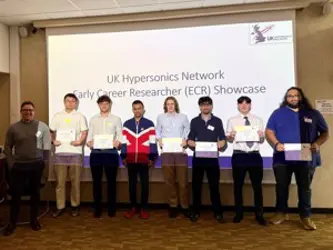

The quality of the presentations demonstrated the breadth of emerging hypersonics research taking place across the UK and generated valuable discussion around common technical challenges, future collaborations and opportunities for student involvement in the wider Network.
ECR & Special Interest Groups
Alongside these engagement activities, the role of the ECR programme within the Network has become more clearly defined through close collaboration with the Special Interest Groups:
Hypersonic Boundary-Layer Transition
Fluid–Thermal–Structure Interaction Special Interest Groups.
Rather than operating independently, the ECR programme is intended to provide a mechanism through which students and early career researchers can contribute directly to the scientific and technical activities of the SIGs. This includes participation in benchmark studies, validation activities, instrumentation development, literature reviews, modelling studies, and other collaborative technical projects that support the wider objectives of the Network.
Contact details
Please contact the Network if you have question or if you would like to participate (hypersonics-network-uk@eng.ox.ac.uk)